


 Español
 Deutsch
 عربى
عربى
1. Introduction In modern society, with the increasing trend of population aging and the accelerating pace of life, the importance of means of transpo...
READ MOREWhy Heavy-Duty Outdoor Mobility Scooters Perform Better on Rough Terrain
Why Terrain Changes Everything About Scooter Design
A sidewalk-only mobility scooter and a scooter built for gravel driveways, park trails, and sloped yards are engineered from two different starting points. Indoor-focused models prioritize a tight turning radius and a low profile so they fit through doorways. A heavy duty outdoor mobility scooter starts from the opposite assumption: the rider will encounter uneven pavement, grass, small inclines, curb cuts, and loose gravel on a regular basis, so the frame, tires, suspension, and motor torque all need extra margin.
This distinction matters because the two categories are often marketed side by side without explaining why the specifications differ. A senior who spends most of the week on smooth flooring has very different needs than one who wants to reach a mailbox at the end of a long gravel driveway, walk a dog around a park loop, or visit a garden that sits on a slight grade. Matching the scooter class to the actual terrain is the single biggest factor in whether the purchase feels liberating or frustrating within the first month of ownership.
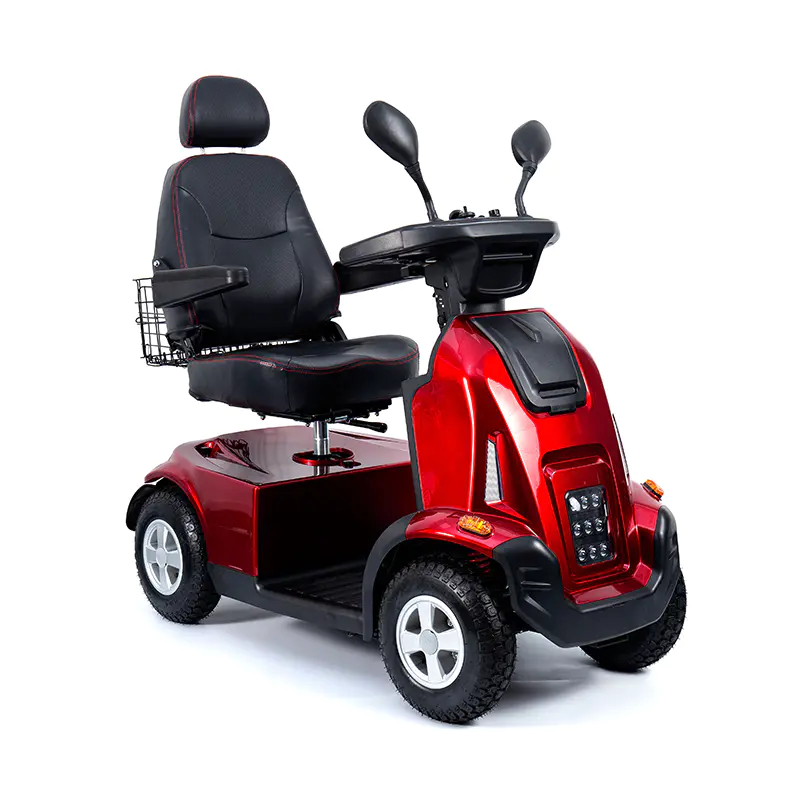
Independent occupational therapy assessments commonly cite ground clearance, tire width, and continuous torque as the three variables that most influence whether a scooter can be used confidently outside the home. Later sections walk through each of these variables with comparative data, so the differences are measurable rather than anecdotal.
Key Engineering Differences: Standard vs Heavy Duty Models
The easiest way to see why heavy duty 4 wheel mobility scooters behave differently outdoors is to compare six core attributes side by side: stability, ground clearance, weight capacity, suspension travel, battery range, and tire traction. The chart below plots a typical standard indoor-oriented scooter against a typical heavy-duty outdoor model on the same six-point scale.
The gap is widest on ground clearance and tire traction, which explains why a scooter that feels perfectly adequate on tile or carpet can struggle the moment it meets a grass strip or a rutted path. Suspension travel and weight capacity follow a similar pattern, since heavier frames and dual-spring or independent suspension systems are what allow a large mobility scooter to absorb bumps without transferring shock directly to the rider.
| Attribute | Standard Indoor Scooter | Heavy Duty Outdoor Scooter |
| Ground Clearance | 2.0 to 3.0 inches | 5.5 to 8.0 inches |
| Tire Type | Solid foam, narrow | Pneumatic or knobby, wide |
| Suspension | None or basic front spring | Independent front and rear |
| Typical Weight Capacity | 250 to 300 lbs | 400 to 500 lbs |
Ground Clearance and Traction: What the Data Shows
Ground clearance is frequently the deciding factor in whether a scooter can cross a curb lip, a garden hose channel, or a slightly raised tree root without stalling. Reviewing typical clearance figures across four common scooter classes makes the practical gap easy to see.
The jump from a standard 4-wheel model to a heavy-duty class is not incremental, it roughly doubles usable clearance. Paired with wider pneumatic or knobby tires, this is what allows an all-terrain electric scooter to hold a straight line across gravel or packed dirt instead of drifting or catching a wheel.
Weight Capacity and Frame Considerations
Weight capacity is not only about rider body weight. It also covers cargo baskets, bags, and any medical equipment carried along for errands or park visits. Undersizing capacity is one of the most common mistakes buyers make, since a scooter running near its limit outdoors loses climbing torque and stopping control exactly when extra terrain resistance is present.
- Compact travel scooters typically top out around 250 to 275 lbs, with little margin for cargo.
- Standard 4-wheel scooters generally support 300 to 350 lbs on flat, even ground.
- Heavy duty 4 wheel mobility scooters are commonly rated from 400 to 500 lbs, reinforced with a steel or hybrid steel-aluminum frame.
- Bariatric-oriented big mobility scooters can extend past 500 lbs with wider seating and reinforced axles.
A useful rule of thumb is to leave at least 15 to 20 percent headroom between actual rider plus cargo weight and the stated capacity. That margin is what preserves climbing power on an incline rather than forcing the motor to work at its absolute ceiling.
How Battery Range Changes With Outdoor Conditions
Manufacturer range figures are usually measured on flat, smooth pavement, which rarely matches real outdoor use. Grass, gravel, and inclines all increase rolling resistance and motor draw, which shortens the miles delivered per charge.
The pattern below shows the same relationship as a continuous trend line across a five-point terrain difficulty index, which is useful when comparing routes that combine several surface types in a single trip.
A battery marketed for twenty-plus miles can realistically deliver closer to half that figure once hills and loose surfaces enter the route, which is why range should always be checked against the actual terrain profile of daily errands rather than the flat-pavement spec sheet.
Choosing the Right Scooter for Daily Outdoor Life
Matching a scooter to daily routine starts with an honest inventory of surfaces covered in a typical week: driveway material, sidewalk condition, park or trail visits, and any slopes near the home. For riders who regularly leave paved paths, an all-terrain mobility scooter with wider tires and higher clearance tends to outperform a standard 4-wheel unit even if the standard model is lighter and easier to load into a vehicle.
Seat design also deserves attention outdoors. A captain's seat with adjustable lumbar support and armrests reduces fatigue on longer outings, while a swivel base makes dismounting on uneven ground safer than a fixed seat. Tiller position should allow a slightly bent elbow at full reach, since a fully extended arm loses steering precision on bumpy surfaces.
| Use Case | Recommended Class | Priority Feature |
| Paved sidewalks, occasional grass | Standard 4-wheel | Turning radius |
| Gravel driveway, mild slopes | Heavy duty 4 wheel | Ground clearance |
| Park trails, uneven yards | All-terrain outdoor | Suspension and tire width |
| Frequent hauling of cargo or equipment | Large mobility scooter | Weight capacity |
A Simple Decision Framework Before Buying
The flow below condenses the buying process into five checkpoints, moving from terrain assessment through to final class selection.
Maintenance, Safety, and Long-Term Value
Outdoor use increases exposure to moisture, dust, and vibration, so a heavy duty outdoor mobility scooter generally needs more frequent upkeep than an indoor-only model. Tire pressure on pneumatic tires should be checked monthly, since underinflation is a common cause of reduced range and sluggish handling. Battery terminals benefit from a quick wipe-down after wet routes, and suspension linkages should be inspected twice a year for loose hardware.
Comparing five-year ownership cost against purchase price often shifts the value equation in favor of the heavier build, since reinforced frames and larger motors typically require fewer repairs under sustained outdoor load.
A well-matched heavy duty outdoor mobility scooter tends to spend fewer days in the shop over its lifespan simply because it is not being operated near the edge of its design limits on a daily basis.
Frequently Asked Questions
Q1: What separates a heavy duty 4 wheel mobility scooter from a standard model?
The main differences are ground clearance, tire width, suspension travel, and weight capacity. Heavy duty models are built with reinforced frames and larger motors so they hold traction and stability on uneven or loose surfaces that a standard scooter is not designed to handle.
Q2: How much weight capacity headroom should be left when choosing a large mobility scooter?
A margin of 15 to 20 percent above rider weight plus typical cargo is a reasonable target. This preserves climbing torque and braking control on inclines rather than operating the motor at its rated ceiling.
Q3: Do outdoor scooters really lose that much battery range on grass or gravel?
Yes. Rolling resistance on grass, gravel, and slopes increases motor draw significantly, so a scooter rated for over twenty miles on pavement may realistically deliver closer to half that on mixed terrain.
Q4: How often should tires and suspension be checked on a big mobility scooter used outdoors?
Pneumatic tire pressure should be checked monthly, and suspension linkages and hardware should be inspected roughly twice a year, more often if the scooter is used on rough trails regularly.
Q5: Is a heavier scooter always the right choice for outdoor mobility?
Not necessarily. If most trips stay on flat pavement with occasional smooth grass, a standard model may be sufficient and easier to transport. The heavier, higher-clearance class is best suited to routines that regularly include gravel, slopes, or uneven ground.
PREV:Power Wheelchair Ramps for Home: Complete Sizing, Safety, and Buying Guide
NEXT:How All-Terrain Mobility Scooters Solve the Weight, Traction, and Stability Limits of Standard Models
NEXT:How All-Terrain Mobility Scooters Solve the Weight, Traction, and Stability Limits of Standard Models
Interested in cooperation or have questions?
News

-
The information provided on this website is intended for use only in countries and jurisdictions outside of the People's Republic of China.
-
Office Address
Room 315, building5, No.45 Songbei Road, Suzhou area, China Pilot Free Trade Zone
-
Factory Address
No. 2 Shanyan Road, Huzhen Town, Jinyun Country, Lishui, Zhejiang, China
-
Mobile Phone
+86 137 7606 7076
-
Email
taylor.liu@heinsmed.com
Stay Connected
lf you can't find the answer you're looking for, chat with our friendly team.
Mobile
Copyright © Suzhou Heins Medical Equipment Co., Ltd. All Rights Reserved.
Custom Mobility Scooters for Elderly Suppliers
Custom Mobility Scooters for Elderly Suppliers