


 Español
 Deutsch
 عربى

1. Introduction In modern society, with the increasing trend of population aging and the accelerating pace of life, the importance of means of transpo...
READ MOREMobility Scooter Safety Features: What Buyers and Distributors Must Check
A mobility scooter that tips backward on a driveway ramp usually shares one root cause: the rear anti-tip wheels sit too high to reach the ground before the centre of gravity passes the rear axle. No brochure mentions it, and a test drive on flat carpet will never reveal it.
The features that prevent most incidents are unglamorous and easy to verify: anti-tip wheels, a fail-safe brake, speed and acceleration limiting, working lights, and a battery management system that cuts power before a cell overheats. Here is what each one does in real use, the numbers worth asking for, and how buyers can check the claims before ordering.
Five Safety Features That Do the Real Work
Check these five before you compare anything else. If one is missing or undocumented, the scooter is not ready for daily outdoor use, however attractive the price looks.
- Anti-tip wheels: rear-mounted wheels sized and positioned to touch the ground before the frame does when weight shifts backwards on a slope.
- A fail-safe brake: usually a spring-applied electromagnetic brake that closes automatically when the throttle is released or the power is cut.
- Speed and acceleration limiting: controller programming that caps the scooter at roughly 6 km/h (4 mph) for pavement use and 12 km/h (8 mph) for road-class models.
- Lighting and reflectors: a front headlight, rear reflectors and an audible horn for shared paths and low-light hours.
- Battery management and thermal cut-off: protection against overcharge, over-current, short circuit and overheating, with a warning before shutdown.
Practical test: ask for the anti-tip contact angle, the brake type and the controller speed settings. A supplier who cannot answer from a test report is estimating.
Stability: Anti-Tip Wheels, Wheelbase and Seat Position
Stability is geometry. Three measurements decide how a scooter behaves on a ramp, a kerb cut or a sharp turn at speed.
Rear anti-tip geometry
On level ground the anti-tip wheels should sit roughly 25 to 40 mm above the surface, so they never interfere with normal driving but make contact early on a climb. Mounted too high, they never touch; mounted too low, they scrape on every driveway apron.
Wheelbase and track width
Four-wheel scooters with a wide track resist sideways tipping and handle road cambers well. Three-wheel versions turn in a tighter radius indoors but can lift a rear corner at speed or on a slope. For outdoor daily use, four wheels is the safer default, at the cost of a wider turning circle.
Seat height and load headroom
The higher and further back the seat, the higher the centre of gravity. Capacity matters just as much: a model rated to 136 kg (300 lb) carrying a 120 kg rider leaves the motor, brake and frame with almost no margin. Allow 20 to 25 percent headroom above the heaviest regular user.
Anti-tip contact angle Track width Seat height Rated load
 YL-08S Heavy-Duty Four-Wheel Folding Mobility ScooterSteel-frame scooter with 24V 350W motor, 20 km range and adjustable seating; check 100 kg load margin and real ramp gradients.View Product →
Published slope ratings deserve the same scrutiny. A heavy-duty folding four-wheel platform rated for a 12 percent climbing capacity is quoting roughly 6.8 degrees, which is less than the steepest section of many multi-storey car park ramps. Compare the rating against the ramps the rider actually meets, not the ones in the showroom.
Braking: What Happens When You Release the Throttle
On most scooters the brake is spring-applied and electrically released. Grip the throttle and it opens; release the throttle or lose power and the spring closes it again. That is why the scooter does not roll away when the battery runs flat.
- Braking distance grows quickly on wet or loose ground. A machine that stops in 1.5 m on dry concrete may need three times that distance on wet paving or gravel.
- A mechanical parking brake is not optional. The tiller lever keeps the scooter stationary while the rider transfers on or off, particularly on any slope.
- Releasing the throttle early on a descent keeps speed under control. Braking hard into a corner is where light scooters become unstable.
When buying in volume, ask for stopping distance data. An electromagnetic brake quoted without a distance gives you nothing to compare.
Terrain, Ground Clearance and Traction
Features that work on a shopping-centre floor can fail on gravel. Three specifications predict how a scooter handles the ground outside the front door.
- Wheel diameter and type: eight-inch solid tyres suit smooth indoor surfaces, while ten to twelve inch pneumatic tyres absorb bumps and grip loose ground far better.
- Ground clearance: most pavement scooters sit 40 to 80 mm off the ground. Anything lower turns kerb cuts, tree roots and drain covers into obstacles.
- Motor power and gearing: a 250 W motor can struggle on a 10 percent slope with a heavy rider, while a high-torque 500 W drivetrain holds speed on the same grade.
All-terrain designs are built around exactly these variables, pairing larger wheels and higher clearance with a wider track and a heavier motor. The trade-off is weight and folded size, which is why a single model rarely suits both a city pavement and a gravel park path.
Visibility and Control Layout
Plenty of incidents happen at walking pace, in poor light, because a driver never saw the rider. Visibility belongs on the safety list, not the accessory list.
- Front LED headlight: bright output with low battery draw, so it stays usable as the charge drops.
- Rear reflectors and a brake light: they help drivers judge distance and deceleration in traffic.
- Horn: loud enough for shared footpaths and car parks, not a novelty buzzer.
The control layout matters as much. A delta tiller supports one-handed steering for riders with limited grip on one side, and an adjustable speed dial lets a carer set a lower limit during rehabilitation. Confirm that the throttle returns to neutral on its own and that the tiller locks firmly at the rider's preferred angle.
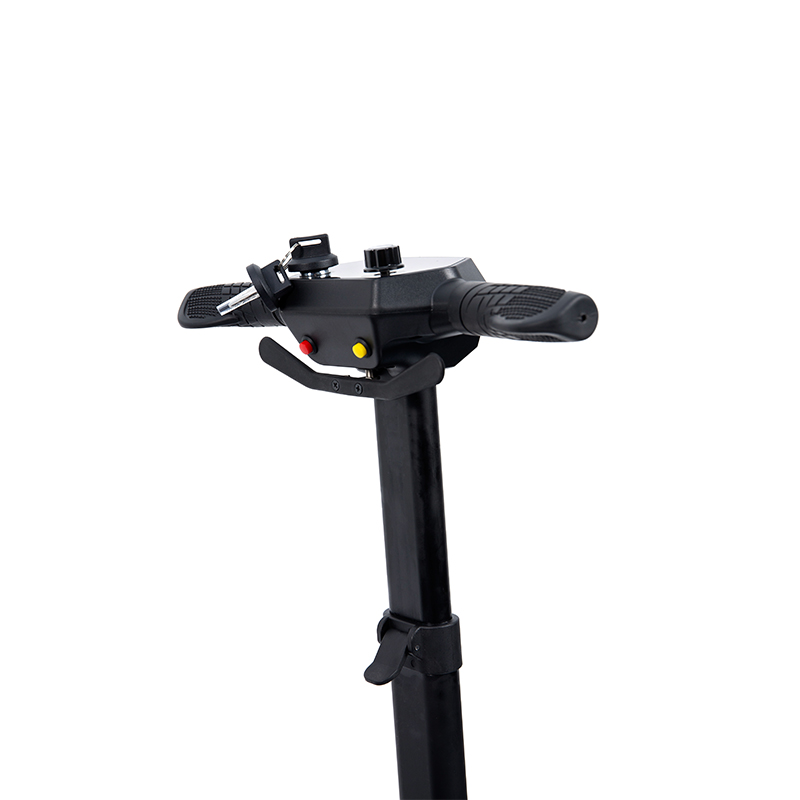 YL-211 Four-Wheel Tourist Electric Scooter for SeniorsLightweight aluminum-frame travel scooter with instant folding, 24V 250W motor, 18 km range, LED headlight and front basket for short trips.View Product →
Small details compound the benefit: an LED headlight plus a front basket on a four-wheel travel scooter makes evening trips and shopping errands both more practical and more visible to others.
Battery and Electronic Safety Features
The battery is the largest energy source on the scooter, so its protection circuits matter as much as its range.
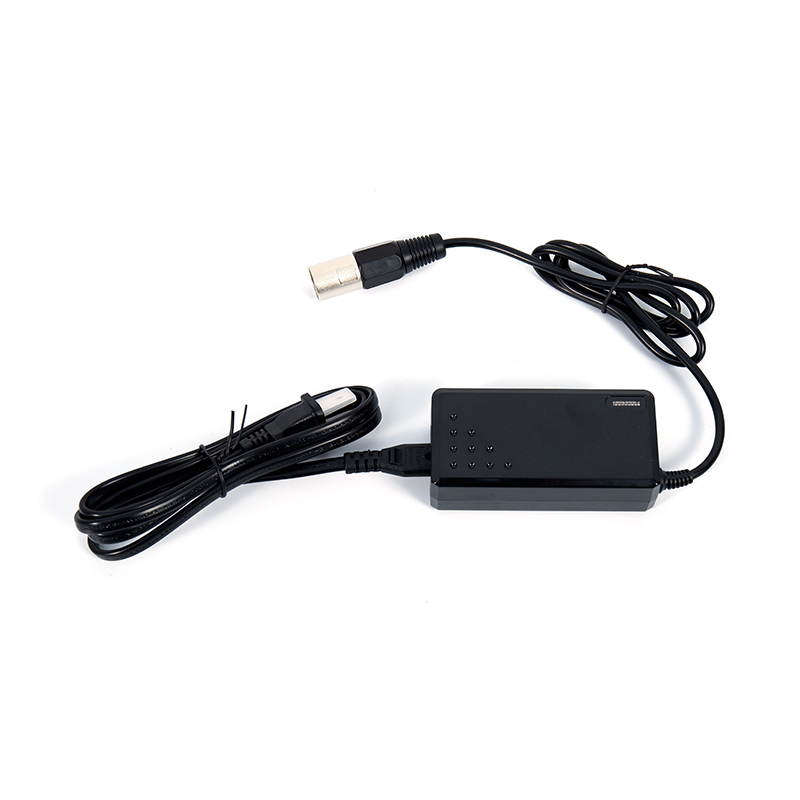
- Charger matching: a charger built for a different chemistry or voltage can overcharge a pack. Battery and charger should be supplied as a matched pair.
- Thermal cut-off: the scooter should warn the rider before shutting down, never stop silently halfway up a hill.
- Low-voltage protection: deep discharge shortens battery life and range, which becomes a safety issue when the rider is far from home.
- Charging habits: charge in a ventilated space away from soft furnishings, and never leave a pack charging overnight in a bedroom.
Maintenance That Keeps Safety Features Working
Safety features degrade quietly. A brake that felt sharp in spring can take two metres longer to stop by autumn if nobody inspects it.
- Before each trip: test the brake at walking speed and check tyres for tread and pressure.
- Weekly: inspect the anti-tip wheels, folding latches, cables and charger leads for wear or looseness.
- Monthly: check visible bolts, the seat fixing, the lights and the horn.
- Annually: have the controller, motor and battery capacity assessed by a technician.
Durability and safety are the same conversation across a five-year ownership period. Our breakdown of what makes a mobility scooter truly durable for long-term use covers the components that fail first. Written manuals help too: documentation for models such as the YL-07, YL-09B, YL-16, YL-211A and YL-985S gives service technicians the torque values and inspection steps they need.
How Buyers and Distributors Should Verify Safety Claims
When you order by the container, safety is a specification and a paper trail rather than a slogan. Three checks catch most problems before they reach end users.
Request the technical file
Ask for brake type and stopping distance, anti-tip wheel position, maximum slope rating, speed settings, motor power and battery management functions, model by model and in writing.
Test production samples
Pull two or three units from the production line rather than accepting a hand-built demonstration scooter. Brake, climb a slope, turn hard and watch the charging behaviour.
Confirm spare parts
Brake assemblies, tyres, controllers and chargers should be available for the model's service life. A scooter with no spare brake unit is a future complaint.
Certification claims deserve the same treatment: ask which standards apply to the specific model and request the certificates with the model numbers listed. Confirm as well that manuals are supplied in the destination market's language, not only in English. Send your requirements and target market and ask for the technical file by model.
Frequently Asked Questions About Scooter Safety
Q1: Are anti-tip wheels required on every mobility scooter?
They are strongly recommended for anything used outdoors or on slopes. Some lightweight indoor models omit them because the low seat and short wheelbase rarely shift weight backwards, but every four-wheel outdoor scooter should have them.
Q2: Does a higher top speed make a scooter less safe?
Not automatically, but speed multiplies every other risk. A road-class model capable of 12 km/h (8 mph) needs better brakes, a wider track and a more visible profile than a 6 km/h pavement scooter. Match the speed class to where the rider actually travels.
Q3: Can a mobility scooter be used on wet ground?
Light rain is usually manageable when the electronics are properly sealed, but wet paving, metal ramps and painted road markings reduce traction sharply. Braking distances can double, so riders should slow down well before junctions and turns.
Q4: What does fail-safe braking actually mean?
The brake holds by spring force and is released electrically. If power is cut, the throttle is released or a fault occurs, the brake closes by default, so the scooter stops instead of continuing to roll.
Q5: How much weight capacity headroom is enough?
Aim for at least 20 to 25 percent above the heaviest regular user. A 136 kg (300 lb) rating comfortably covers a 110 kg rider, but a 130 kg rider pushes the motor, brake and frame close to their design limits.
Safety features are cheap to specify at the design stage and expensive to retrofit. Anti-tip geometry, a fail-safe brake, sensible speed limits and a battery that knows when to stop cost very little when they are engineered in from the first prototype, and they are the reason a rider gets home without an incident.
Whether you are buying one scooter for a parent or sourcing a container for a distribution network, the same rule applies: ask for the numbers, test a production unit, and keep the manual with the machine.
PREV:No previous article
NEXT:mobility scooter vs electric wheelchair: Practical Applications, Selection, Performance
NEXT:mobility scooter vs electric wheelchair: Practical Applications, Selection, Performance
Interested in cooperation or have questions?
News

-
The information provided on this website is intended for use only in countries and jurisdictions outside of the People's Republic of China.
-
Office Address
Room 315, building5, No.45 Songbei Road, Suzhou area, China Pilot Free Trade Zone
-
Factory Address
No. 2 Shanyan Road, Huzhen Town, Jinyun Country, Lishui, Zhejiang, China
-
Mobile Phone
+86 137 7606 7076
-
Email
taylor.liu@heinsmed.com
Stay Connected
lf you can't find the answer you're looking for, chat with our friendly team.
Mobile
Copyright © Suzhou Heins Medical Equipment Co., Ltd. All Rights Reserved.
Custom Mobility Scooters for Elderly Suppliers
Custom Mobility Scooters for Elderly Suppliers