


 Español
 Deutsch
 عربى
عربى
1. Introduction In modern society, with the increasing trend of population aging and the accelerating pace of life, the importance of means of transpo...
READ MOREHow to Choose a Lightweight Folding Mobility Scooter for Airline and Car Travel
What Makes a Mobility Scooter Truly Portable for Travel
Portability is not a single feature. It is a combination of weight distribution, hinge engineering, and how quickly a device can move from riding mode to a stored, luggage-like state. For active seniors who split time between home, airports, and family visits, a folding mobility scooter needs to satisfy three practical tests at once: it must fit in a standard car trunk without disassembly of extra parts, it must be liftable by one adult without back strain, and it must fold down in under a minute without tools.
Many buyers assume that "foldable" and "lightweight" are the same claim. They are related but distinct. A scooter can fold into a compact shape yet still weigh close to 30 kilograms because of a steel frame or a large battery pack. True travel-ready models balance frame material, battery chemistry, and hinge count so the folded unit stays under a weight that most adults can carry up a few steps or lift into a trunk.
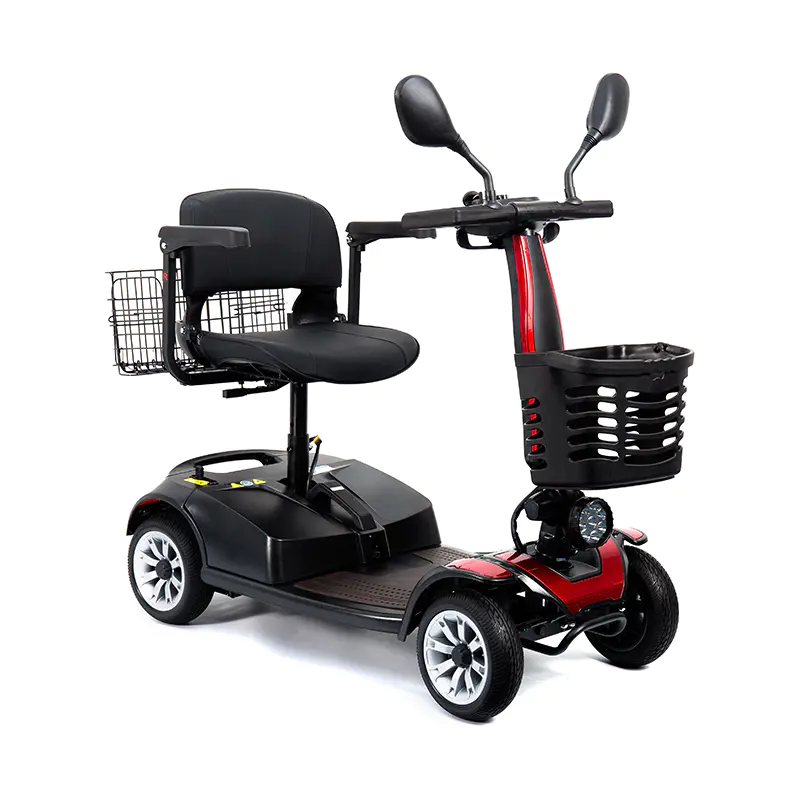
The following sections break down the technical differences between folding styles, the weight brackets worth comparing, airline battery rules, and the maintenance habits that keep a travel scooter reliable across hundreds of trips.
Folding vs Lightweight Collapsible Mobility Scooters: What Is the Real Difference
The terms overlap in marketing copy but describe two distinct engineering approaches. A hinge-fold design uses one or two main pivot points, usually at the base and the tiller column, so the entire frame drops into a flatter profile in one continuous motion. A telescoping or multi-part collapsible design instead separates into two or three modules, such as the seat, base, and battery pack, which are then reassembled or nested for storage.
| Design Type | Typical Fold Time | Folded Footprint | Best Use Case |
|---|---|---|---|
| Single hinge fold | 10 to 20 seconds | Compact, single unit | Frequent short trips, car trunk storage |
| Multi-part collapsible | 1 to 3 minutes | Smaller per piece, more total pieces | Long-haul flights, checked luggage |
| Manual disassembly | 3 to 5 minutes | Smallest possible pieces | Tight closets, small elevators |
Neither approach is universally better. A single hinge fold favors speed and simplicity, which matters at a curbside drop-off or a train platform. A multi-part collapsible unit favors people who need to lift smaller individual pieces rather than one heavier folded block, which is often the deciding factor for someone with limited upper body strength.
Weight and Size Benchmarks to Check Before You Buy
Weight class is the single most useful number when comparing lightweight collapsible mobility scooters across different sellers. Manufacturers rarely agree on marketing language, so relying on the actual kilogram figure for the heaviest single piece, usually the battery or the base frame, gives a more honest comparison than a general product description.
| Weight Class | Heaviest Single Piece | Typical Folded Size | Who It Suits |
|---|---|---|---|
| Ultra-light | Under 12 kg | Small carry-on range | Solo flyers, limited lifting strength |
| Light | 12 to 18 kg | Medium suitcase range | Regular car trunk storage |
| Standard travel | 18 to 25 kg | Larger, still one-person liftable | Occasional lifting help available |
| Heavy duty travel | Over 25 kg | Requires two-person lift or ramp | Higher weight capacity needs |
A common mistake is comparing total product weight instead of the heaviest single component. A scooter with a 22 kilogram total weight split into a 9 kilogram base and a 13 kilogram seat frame is often easier to manage than a 19 kilogram scooter that folds into one rigid 19 kilogram block.
Airline Approved Mobility Scooters and TSA Battery Rules Explained
Battery regulations, not scooter size, are usually the reason a device gets delayed at check-in. Airlines generally follow watt-hour thresholds set for lithium battery air travel, and understanding where a scooter's battery falls in that range prevents last-minute problems.
- Most carriers allow lithium batteries up to 300 watt-hours without special approval, provided the battery is removable and carried in a protective case.
- Batteries between 300 and 360 watt-hours often require prior notice to the airline, sometimes limited to two spare units per passenger.
- Sealed lead-acid or gel batteries face different handling rules and are frequently restricted to checked cargo only, which limits their practicality for a genuine portable travel mobility scooter.
- A watt-hour rating should be printed directly on the battery casing or listed in the product manual, since staff at the gate will ask for this figure rather than accepting an estimate.
Before booking a flight, contacting the airline's disability or special assistance desk directly, rather than relying only on general cargo policy pages, gives the most accurate answer for a specific battery model and travel date.
How a Compact Folding Mobility Scooter Fits in a Car Trunk
Trunk compatibility depends on folded length more than folded height, since most sedan trunks are wider and taller than they are deep near the rear seat divider. A folded scooter that measures under 70 centimeters in length will generally clear a mid-size sedan trunk opening, while anything closer to 90 centimeters may need an SUV or hatchback.
| Vehicle Type | Typical Trunk Depth | Comfortable Folded Length |
|---|---|---|
| Compact sedan | Around 60 to 70 cm | Under 65 cm |
| Mid-size sedan | Around 75 to 85 cm | Under 75 cm |
| Hatchback or SUV | 90 cm and above | Under 90 cm |
Wheel placement also matters. Scooters with wheels that tuck fully inside the folded frame slide into a trunk more smoothly than models where a wheel or footplate extends outward, since a protruding edge can catch on trunk carpet or wheel wells during loading.
The Folding Process Explained Step by Step
A reliable fold sequence follows a predictable order across most single-hinge designs. Learning this order before a first solo trip prevents fumbling at a busy curbside or gate.
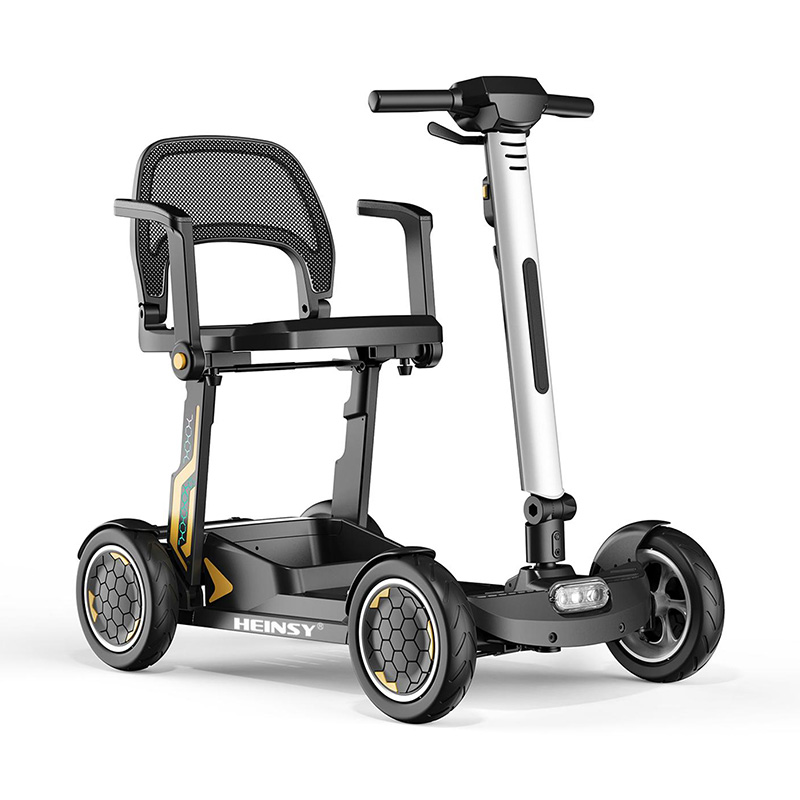
Practicing this sequence a few times at home, ideally on flat ground with the brake engaged, builds the muscle memory needed to fold a compact folding mobility scooter confidently under time pressure at an airport gate.
Manual Fold vs Automatic Fold: Which Mechanism Suits You
Automatic folding scooters use a remote control or a key switch to trigger a motorized fold sequence, while manual models rely on hand levers and gravity-assisted hinges.
- Automatic fold: requires almost no physical effort, but adds weight from the motor assembly and depends on battery charge to operate.
- Manual fold: works even with a depleted battery, weighs less overall, but demands more hand and wrist strength during the process.
- Assisted manual fold: uses spring-loaded hinges that reduce the force needed without adding motorized parts, a middle ground many travelers prefer.
For someone traveling with a companion who can help lift, a manual design often wins on weight savings. For a solo traveler with limited grip strength, the added convenience of an automatic fold can outweigh the extra kilograms.
Battery Range and Charging Habits for Long Travel Days
Range figures on a specification sheet are measured under ideal lab conditions: flat ground, moderate temperature, and a rider near the low end of the weight capacity. Real-world range on uneven sidewalks or in cold airport terminals typically runs 15 to 25 percent lower.
| Battery Type | Typical Range | Charge Time | Airline Friendliness |
|---|---|---|---|
| Lithium-ion, removable | 15 to 25 km | 4 to 6 hours | High, when under watt-hour limits |
| Lithium-ion, fixed | 15 to 25 km | 4 to 6 hours | Low, harder to inspect and remove |
| Sealed lead-acid | 10 to 20 km | 6 to 8 hours | Very low, often cargo restricted |
Charging a scooter fully the night before a travel day, rather than topping it up at a layover, avoids relying on unfamiliar outlets and reduces the chance of arriving with a partial charge in an unfamiliar city.
Comfort, Stability and Safety Features Worth Checking
Beyond folding mechanics, day-to-day comfort determines whether a scooter actually gets used on trips or stays in the closet after the first inconvenient outing.
- A swiveling seat reduces strain when getting on and off, especially in tight hotel bathrooms or airplane aisles.
- Adjustable armrests and tiller height accommodate different rider heights within the same household.
- A tighter turning radius, generally under one meter, matters more in crowded terminals than top speed does.
- Ground clearance of at least 6 centimeters helps on uneven curb cuts and cobblestone paths common in older city centers.
- Checking the stated weight capacity against the rider's actual weight, with some margin, preserves battery life and motor longevity.
Maintenance Habits That Extend the Life of a Travel Scooter
Frequent folding and unfolding puts more mechanical stress on hinges and connectors than stationary home use, so a short maintenance routine matters more for travel scooters than for models that rarely leave a single room.
- Wipe hinge points after exposure to rain or airport tarmac dust, since grit accelerates hinge wear.
- Check tire pressure or tread condition before each major trip, particularly for pneumatic tires.
- Store the battery at roughly half charge if the scooter will sit unused for several weeks.
- Inspect fold-lock pins and levers for looseness every few months, tightening as needed.
- Keep the original charger and manual together with the scooter case so airline staff can verify battery specifications quickly if asked.
Frequently Asked Questions
Q1: How heavy should a folding mobility scooter be for airline travel?
Most airline-friendly models fall between 12 and 20 kilograms for the heaviest single folded piece, which one adult can typically lift into an overhead bin area or a car trunk without assistance.
Q2: Can any lithium battery scooter fly without special approval?
Not automatically. Batteries under roughly 300 watt-hours are usually approved without extra steps, while higher-capacity batteries often require advance notice to the airline.
Q3: Is a multi-part collapsible scooter better than a single hinge fold for flights?
It depends on lifting ability. Multi-part designs break into smaller, lighter pieces, which suits travelers who prefer several light lifts over one heavier one.
Q4: How often should hinges be checked on a travel scooter?
A quick visual and tactile check every few months is enough for occasional travelers, while frequent flyers should inspect hinge tightness before every major trip.
Q5: Does folding a scooter frequently shorten its lifespan?
Frequent folding does add wear to hinge components over time, but routine cleaning and periodic tightening of lock pins largely offsets this extra mechanical stress.
PREV:How to Choose the Right Mobility Scooter for Your Lifestyle and Mobility Needs
NEXT: How Does Insurance Actually Decide Who Qualifies for a Mobility Scooter?
NEXT: How Does Insurance Actually Decide Who Qualifies for a Mobility Scooter?
Interested in cooperation or have questions?
News

-
The information provided on this website is intended for use only in countries and jurisdictions outside of the People's Republic of China.
-
Office Address
Room 315, building5, No.45 Songbei Road, Suzhou area, China Pilot Free Trade Zone
-
Factory Address
No. 2 Shanyan Road, Huzhen Town, Jinyun Country, Lishui, Zhejiang, China
-
Mobile Phone
+86 137 7606 7076
-
Email
taylor.liu@heinsmed.com
Stay Connected
lf you can't find the answer you're looking for, chat with our friendly team.
Mobile
Copyright © Suzhou Heins Medical Equipment Co., Ltd. All Rights Reserved.
Custom Mobility Scooters for Elderly Suppliers
Custom Mobility Scooters for Elderly Suppliers