


 Español
 Deutsch
 عربى

1. Introduction In modern society, with the increasing trend of population aging and the accelerating pace of life, the importance of means of transpo...
READ MOREMobility Scooter Hill Climbing Ability: What Really Matters Before You Buy
Living on a street with a noticeable incline changes how you shop for a mobility scooter. A model that feels reassuring on flat showroom floors can slow to a crawl on a 6% grade, struggle on a 10% driveway, and stop completely on steeper ramps. Hill climbing ability is not an optional feature for riders in hilly areas; it is the feature that determines whether the scooter remains useful outside the house.
The engineering behind climbing performance is measurable and straightforward: motor power, total weight, tire grip, ground clearance, battery condition, and controller calibration all play defined roles. Once you understand how these interact, comparing models becomes a matter of reading specs and verifying real-world conditions rather than guessing.
What Does a Mobility Scooter's Grade Rating Actually Mean?
Manufacturers express hill climbing ability as a grade percentage. A scooter rated at 12% can climb a slope that rises 12 meters for every 100 meters of horizontal distance, roughly a 6.9-degree angle. That is steeper than most curb ramps and similar to the grade of many residential driveways.
8.3% ADA curb ramp Baseline accessibility
12% YL08S rated climb Heavy-duty folding scooter
20%+ Extreme driveways Top-end scooter territory
The table below shows slope grades you are likely to encounter in daily travel:
| Slope Example | Grade % | Typical Location |
|---|---|---|
| ADA-compliant curb ramp | 8.3% | Sidewalk crossings |
| YL08S rated climbing capacity | 12% | Hilly residential streets |
| Steep parking garage ramp | 15-20% | Multi-storey car parks |
| Extreme residential driveway | 20%+ | Mountain-side homes |
Two things matter when reading these numbers. First, the rating is a maximum capability, not a comfortable cruising condition. Climbing at the rated grade puts the motor under high stress, and the controller may reduce power if the motor overheats. Second, the rating is usually measured with a fully charged battery and a rider at or below the maximum load, so real-world results vary as those conditions change.
What Determines a Mobility Scooter's Hill Climbing Performance
Five engineering factors combine to decide how well a scooter climbs. Each one adjusts the balance between motor output and the forces working against it.
1. Motor Power and Torque
Motor wattage gets the attention, but torque is what actually pushes the wheels against a slope. A 500W motor with a geared transaxle produces more usable torque at low speed than a direct-drive 300W motor, which is exactly what a hill demands. Sustained climbing also generates heat; a well-designed motor and controller manage thermal load without cutting power halfway up.
2. Total Weight and Load Distribution
Total weight is the sum of the scooter, the rider, and anything stored in the basket. A scooter rated for 120 kg may handle a 12% grade with a 65 kg rider but struggle with a 110 kg rider. Weight distribution matters too: a central, low-mounted battery improves stability, while a nose-heavy scooter can lose front-wheel traction on an incline.
3. Tire Design and Traction
Pneumatic tires provide better grip and shock absorption than solid tires, especially on wet pavement. Tread depth affects performance on grass, gravel, and dirt: deeper tread grips loose surfaces better, while street tread rolls quietly on hard surfaces. The drive wheels need consistent ground contact, so larger-diameter wheels and suspension help on uneven inclines.
4. Ground Clearance and Wheelbase
Ground clearance determines whether the chassis clears curb transitions, speed bumps, and small obstacles without bottoming out. A longer wheelbase spreads the scooter's footprint and improves stability as weight shifts rearward during a climb.
5. Battery Output and Controller Limits
A fully charged battery delivers current more readily than one at 30%. Under heavy load, battery voltage sags and motor torque drops. The controller also caps maximum current; a conservative setting can limit climbing even when the motor has spare capacity. This is why the same scooter may climb a hill early in a ride but struggle to repeat it later.
Why the Rated Number Is Not the Whole Story
The grade rating on a specification sheet is measured in ideal conditions. Your driveway, your rider weight, and your battery state at the end of a trip all modify that number.
An extra 10 kg of cargo changes the safety margin. A long trip that drains the battery to half will reduce available torque. Cold weather slows battery chemistry, and under-inflated tires increase rolling resistance. Even the surface matters: wet asphalt and loose gravel reduce tire grip well before the motor runs out of power.
Hills also accumulate. A single 10% grade is different from a route with three successive climbs, because the motor and battery get no recovery time between them. Riders who plan routes with repeated inclines should choose a scooter rated above the steepest single slope they expect to meet.
How to Choose a Mobility Scooter for Hilly Terrain
When you compare mobility scooters for hilly areas, use this checklist:
- Find the official grade rating and note the load and battery conditions it assumes.
- Check motor wattage and whether the drivetrain is geared for low-speed torque.
- Compare total load capacity with your expected weight plus cargo, leaving a safety margin.
- Choose pneumatic tires with tread suited to your local surfaces.
- Verify ground clearance for the curb transitions you cross regularly.
- Test the scooter on a real slope of about 10% with your own weight, not just on flat ground.
Motor output deserves special attention for steep terrain. If most of your routes involve grades near or above 12%, compare power specifications carefully - our comparison of 1000W motor scooters for steep climbs shows how much variation exists within the same wattage class.
Heins Mobility Scooters That Handle Hills Well
Heins builds several mobility scooters with hill climbing as a design priority. The three models below cover different rider profiles and terrain types.
YL08S - Rated 12% Climbing Capacity
The YL08S heavy-duty 4-wheel folding scooter is the clearest example of a model with published climbing performance in the Heins lineup. Its 12% rated capacity suits hilly residential streets, parking garage ramps, and suburban driveways. The folding frame makes it practical for transport, so riders can use it both at home and while traveling.
 Heins YL-08S Heavy-Duty 4-Wheel Folding Mobility Scooter with 12° Climbing CapacityThis folding scooter offers a rated 12% climbing ability and a 20 km range, making it a practical choice for hilly streets and transportable travel. Its steel frame and ergonomic seating suit daily commutes and leisure rides.View Product →
TK500 - High-Power All-Terrain Performance
The TK500 prioritizes motor output and chassis durability over portability. Built as a 4-wheel all-terrain recreational scooter, it is designed for riders who need sustained torque on rough ground, gravel paths, and steep entryways. If your daily route crosses uneven terrain, the TK500's heavy-duty construction provides the stability that lighter scooters lack.
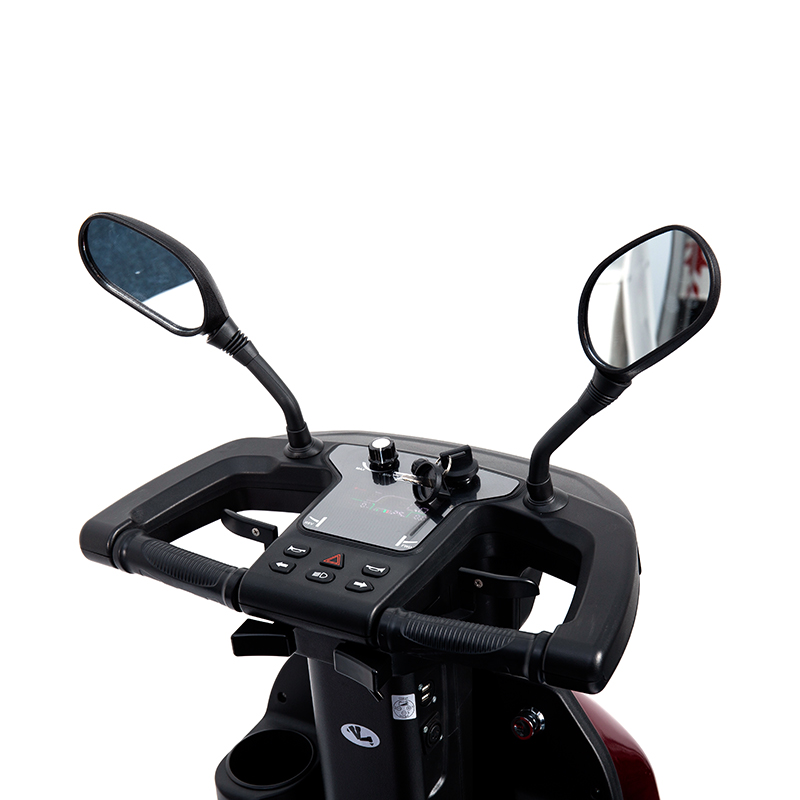 TK-500 Heavy-Duty High-Power 4-Wheel All-Terrain Electric Recreational ScooterBuilt for rough ground, this scooter features a reinforced frame, professional suspension, and high-torque motor. It suits riders needing stability on gravel, grass, and uneven paths, with a design emphasizing durability and comfort.View Product →
YL16 - All-Terrain Mobility Across Mixed Surfaces
The YL16 combines an all-terrain frame with a disability-focused design, making it a strong option for riders with limited lower-body strength who still need outdoor mobility. Its 4-wheel configuration and reinforced body help maintain traction on grass, dirt, and uneven pavement where a standard commuter scooter would slip.
For the steepest conditions, the all-terrain electric scooter category typically combines larger wheels, higher motor output, and reinforced frames that hold up better than standard commuter models.
Frequently Asked Questions About Hill Climbing
Q1: What does a 12% hill climbing rating mean?
A 12% rating means the scooter can climb a slope that rises 12 meters for every 100 meters of horizontal distance, roughly a 6.9-degree angle. The rating assumes a fully charged battery and a rider at or below the stated load capacity, so results vary with weight, cargo, and battery state.
Q2: Can a mobility scooter climb a steep driveway?
A scooter rated for 12% can handle most residential driveways up to that grade when the rider is within the load limit. Driveways steeper than 15% typically call for a heavy-duty or all-terrain model with higher motor output and better tire traction.
Q3: Does rider weight affect climbing performance?
Significantly. Total weight, including the scooter, rider, and cargo, is a direct factor in climbing ability. The same scooter that climbs a 12% grade with a 60 kg rider may fail the same slope with a 110 kg rider. Always keep a weight margin between your total and the rated capacity.
Q4: Why is my scooter climbing worse than when it was new?
Check tire pressure, battery health, and controller error codes first. Under-inflated tires increase rolling resistance, aging batteries lose voltage under load, and a thermal safety feature may limit power if the motor has been overheating. These issues reduce climbing performance before they affect flat-ground speed.
The Bottom Line
The best mobility scooter for hilly areas is not necessarily the most expensive one. It is the model whose motor, weight, tires, and controller match your actual terrain and load. Start with the published grade rating, then look at the engineering behind it. A scooter that climbs reliably is not a luxury; for many riders it is the difference between staying independent and staying home.
PREV:No previous article
NEXT:Motorized Scooter Trailer Guide: How to Choose & Transport Safely | HeinsMed
NEXT:Motorized Scooter Trailer Guide: How to Choose & Transport Safely | HeinsMed
Interested in cooperation or have questions?
News

-
The information provided on this website is intended for use only in countries and jurisdictions outside of the People's Republic of China.
-
Office Address
Room 315, building5, No.45 Songbei Road, Suzhou area, China Pilot Free Trade Zone
-
Factory Address
No. 2 Shanyan Road, Huzhen Town, Jinyun Country, Lishui, Zhejiang, China
-
Mobile Phone
+86 137 7606 7076
-
Email
taylor.liu@heinsmed.com
Stay Connected
lf you can't find the answer you're looking for, chat with our friendly team.
Mobile
Copyright © Suzhou Heins Medical Equipment Co., Ltd. All Rights Reserved.
Custom Mobility Scooters for Elderly Suppliers
Custom Mobility Scooters for Elderly Suppliers